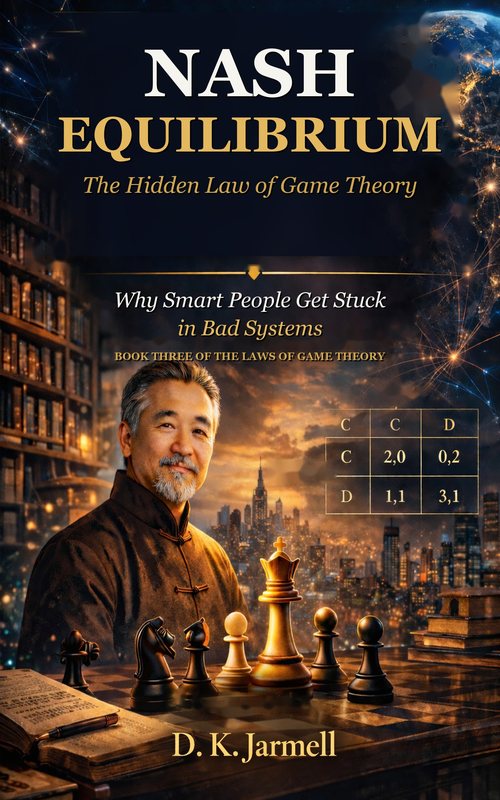
Nash Equilibrium: The Hidden Law of Game Theory
Why Smart People Get Stuck in Bad Systems — Lessons from Professor Jiang
Book Three of The Laws of Game Theory
Nobody plans the traffic jam. Nobody wants it. Everybody builds it.
Every morning, several hundred thousand people independently make a sensible decision and jointly produce a disaster. Each checks a screen. Each takes the route the screen says is faster. Each is correct. By nine o'clock the faster route is the slower one, nobody has broken a rule, and everybody is late.
That is the subject of this book, and it contradicts the way we are trained to explain bad outcomes. When something goes wrong at scale we look for someone at fault. The search is satisfying and it is usually wrong.
The idea
In 1950 a young mathematician described a situation in which no player can improve their position by changing strategy alone, given what everyone else is doing. Such a situation is stable. It will hold. And — this is the part that matters — it does not have to be good.
An equilibrium is not an optimum. It is a resting point. A system can settle into an outcome that every participant dislikes and stay there indefinitely, because the first person to move alone would only make their own position worse.
Once you can see that structure, you cannot stop seeing it.
Where it shows up
- A price war that both companies wanted to avoid and neither can end
- An arms race where each state arms for safety and both become less safe
- An industry where everyone works punishing hours because the first to stop loses the promotion
- A meeting where nobody says the obvious thing, because the first to say it pays for it
- A school system that exhausts its children and cannot reform itself
The situations look nothing alike. The machinery underneath them is identical.
Inside this book
Nineteen chapters, from the jam nobody chose to a closing chapter that states what the framework predicts, precisely enough to be wrong.
- The full mechanism worked through: the Prisoner's Dilemma, Chicken, and the commons a crowd consumes without anybody defecting against anybody
- Nash himself — the man who found the fixed point, and what it cost him
- Axelrod's tournaments, and the four properties of the strategy that kept winning them
- Why the most famous illustration of this idea — the bar scene from the film about Nash — is not an equilibrium at all, and why correcting it is the fastest way to see what the definition really says
- Why being unreadable wins one kind of contest and loses the other
- How removing your own choices can increase your power
- Why information — and what each side believes the other knows — decides more than capability
- Why adding an option can make everyone worse off
- The eight elements any stuck situation decomposes into: the players, their incentives, their choices, their information, their risks, their time horizon, their capacity to cooperate, and the rules
Four appendices follow: all twenty-seven laws of Books One and Two set out as equilibria, the payoff tables in full, what would prove the book wrong, and where the ideas came from.
Who it is for
Anyone who has watched intelligent people produce something none of them wanted, and suspected the problem was not the people. No mathematics, no jargon, and no prior volume required — this is the one book in the series you can hand to someone who has never read a word of the others.
Buy on Amazon Next: Book Four →
Last reviewed 27 September 2026